Ancient Road at Megalo Kavouri Beach
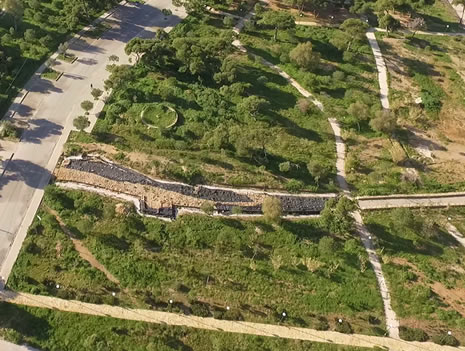
During the landscaping works at Megalo Kavouri beach in 2013, a significant section of an ancient road artery came to light. This is the cart road that connected the centre of the ancient municipality of Aixonidai Ales with the harbour of the coastal front, which was organised along this particular shoreline.
The total excavated length of the road is 300m and is defined by two retaining walls that enclose and support the roadway. It was constructed for the most part on a gentle hillside, with an east-west axis, however at its coastal section it turned southward, ending at the present-day shoreline. The width of the road is not constant and ranges from 1.90m to 6.10m. The road surface is mainly paved with stone, while in a limited area an earthen-beaten surface is preserved, in which wheel ruts from carts can be discerned. Openings in the northern retaining wall served the drainage of rainwater.
The "harbour road", as we conventionally call it, intersected perpendicularly with two road arteries, one heading north and one heading south. At the intersection of the harbour road with the northern lateral road artery, a building of rectangular floor plan was identified. We presume the existence of a "guard post" in the building, which would have controlled the passage of carts and the movement of goods.
Many repair phases have been identified along the same alignment of the road, and only one deviation of its course at the eastern end, which however, based on the construction method, does not differ significantly in date from the rest of the structure. Based on the pottery, but mainly on the coins collected, the harbour road axis must have been in use throughout the 4th century and up to the 2nd century BC.
Due to the extent and good condition of the road, questions immediately arose regarding how to manage the find. The funding provided by Mr. Athanasios Martinos for the completion of the excavation research, the preparation of conservation and promotion studies, and the financing of their implementation proved decisive. The primary objective of the studies carried out was the integration of the ancient road into the natural environment, and secondarily the experiential engagement of visitors with the ability to walk along it.
To date, the entire excavated section of the road has been conserved and the retaining walls have been reconstructed. The reconstruction of the road surface and the landscaping of the wider surrounding area remain pending. The completion of the project will serve as a point of reference for the management and integration of ancient remains into the urban fabric of a modern city.
Access Directions.
* Tram to Voula and bus: 117 Glyfada – Voula - Vouliagmeni – Vari * Buses: A1: Piraeus - Voula KTEL Attica Athens – Sounio